
“Freedom of mind is the real freedom.”
— B.R. Ambedkar
Debate activities for students bring this idea to life. Just like cyclists learn balance and control before riding freely, students first learn to structure their ideas and communicate effectively before convincing others in a secure and encouraging environment.
Through engaging discussions and friendly debates, they develop courage, critical thinking, and the confidence to voice their opinions fearlessly. These are the skills that stay with them, quietly shaping who they are.
Long after they leave the classroom, they carry this confidence and courage into the world.
Why Classroom Debate Activities Matter
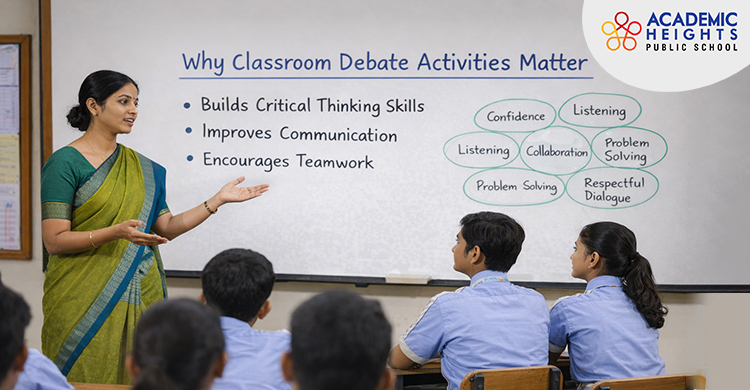
Classroom debate activities are more than just talking. Let’s find out why they matter, how they make learning exciting, and what students gain from taking part.
Improve Public Speaking Confidence
Public speaking skills for students are like tuning an instrument — the more it’s practised, the clearer, stronger, and more confident the voice becomes.
With each opportunity, ideas become clearer, thinking gets sharper, and speaking becomes more confident, enabling students to express themselves with real impact.
Develop Critical Thinking Skills
For children, developing critical thinking abilities is like working out their brains without the need for sweatbands!
Every debate, question, or tricky problem stretches thinking, flexes reasoning, and trains students to spot clever solutions, dodge mental traps, and navigate ideas like a pro.
Encourage Active Listening and Respectful Dialogue
Promoting respectful dialogue and active listening means paying attention to what others are saying rather than preparing a response in the middle of a phrase.
It turns chaotic debates into real conversations, helps ideas land, and, guess what, it also prevents accidental arguments over who interrupted first!
Build Teamwork and Leadership Skills
Classroom debate activities encourage students to think beyond “me” and collaborate with others. You may wonder: Who leads the argument? Who supports it? Who unites everyone?
During the process, leadership develops organically, teamwork gets stronger, and students discover how strong voices perform even better when they collaborate.
Encourage Active Listening and Respectful Dialogue
The way that discussions develop is reshaped by promoting respectful language and attentive listening. Students gain the ability to pause, take in, and respond with intent.
Voices aren’t just heard—they’re understood.
Discussions grow deeper, disagreements remain respectful, and communication becomes strong, purposeful, and grounded in mutual respect.
Build Teamwork and Leadership Skills
Roles naturally develop during debates; one person presents the argument, others strengthen it with evidence, and the team modifies its approach as necessary.
Every decision, response, and strategy moment helps students build teamwork and leadership skills while thinking on their feet and collaborating effectively.
5 Classroom Debate Activities for Students
5 Debate activities for students aren’t what you expect—each one challenges thinking, sharpens voices, and reveals skills students didn’t know they had.
1. Four Corners Debate
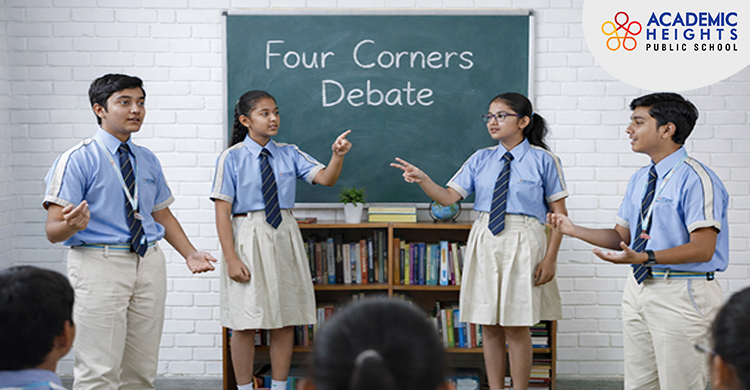
Students move to a corner labelled Strongly Agree, Agree, Disagree, or Strongly Disagree during this debate.
Pose a question like “Should social media have age limits?” and see the responses that emerge. Arguments move across the room, opinions begin to shift, and midway through, someone pauses, rethinks, and walks to another corner!
It’s lively and engaging—a clear reminder that strong ideas have the power to challenge perspectives and change minds.
2. Balloon Debate:

In this debate, students imagine they are all in a hot air balloon that’s slowly sinking. To save themselves, each student must argue why they should stay on board.
For example, they could argue over who should be given the final seat: APJ Abdul Kalam or Mahatma Gandhi. Peers vote, and the student with the weakest argument “falls” first.
3. Think–Pair–Share Debate:
Students first think about a question, like ‘Should exams be shorter?’ After that, they pair up with a classmate to exchange ideas before sharing with the class.
The debate sparks lively discussions — and you know what? Even shy students often surprise everyone! It creates a comfortable space to test ideas without pressure.
Gradually, confidence builds, and more voices find the courage to speak up.
4. Role-Play Debate:
In debate activities for students, role-play debates let participants step into someone else’s shoes.
Imagine debating as Virat Kohli or Sundar Pichai. Students learn empathy, sharpen arguments, and make debates lively, interactive, and unforgettable. They step into someone else’s shoes and see issues from a new perspective.
Each argument becomes a chance to think quickly, respond confidently, and engage the whole class.
5. Pros and Cons Challenge Debate:
In this debate, students pick a topic—like “Should smartphones be allowed in classrooms?”—and explore both pros and cons.
Every participant makes an argument, responds to counterarguments, and defends their position. In a dynamic setting, this exercise improves communication, critical thinking, and quick reasoning.
This demonstrates how weighing advantages and disadvantages makes arguments stronger, sharper, and more convincing in a lively and interactive environment.
How Teachers Can Prepare Students for Debate
Unlocking student communication skills isn’t just about talking—it’s about strategy, confidence, and clarity. Let’s explore how teachers can guide students to express themselves effectively in debates.
Choose Age-Appropriate Topics
Picking an age-appropriate debate topic can make all the difference! Challenge them with questions like: ‘Should uniforms be mandatory or optional?’ or ‘Is homework actually helpful?’
The goal is to pique students’ interest, get them thinking, and keep them all engaged—because a great topic makes the argument memorable.
Teach Basic Debate Rules and Etiquette
Rules might sound boring, but teaching debate etiquette changes everything. Students gain knowledge about how to listen intently, when to speak, and how to answer without interrupting others.
Discussions become more flexible, ideas are exchanged, and everyone, even the silent ones, has an opportunity to shine.
Encourage Respectful Disagreement
Confidence-building activities for students show that it’s okay to disagree—as long as it’s done respectfully. So mentors, let’s cheer students on to share their ideas, disagree respectfully, and really listen!
Through this support, students gain the ability to think critically, answer intelligently, and confidently express their viewpoints while maintaining constructive discussion and respecting everyone’s opinion.
Provide Feedback and Reflection Time
Once the debate ends, it’s important to give students some time to think.
They can think about what went well, what didn’t, and what to try next time. This introspection improves abilities, increases self-assurance, and transforms every conversation into a real educational experience.
Tips to Improve Public Speaking Through Debates
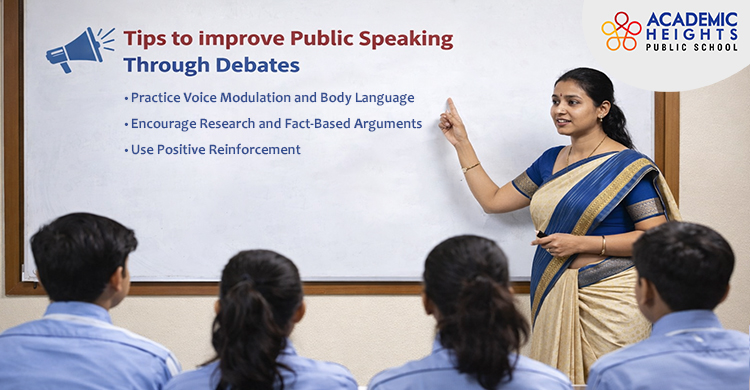
Debate activities for students hold secrets to stronger voices, sharper thinking, and confident expression. Let’s find out how these exercises can transform public speaking in unexpected ways.
Practice Voice Modulation and Body Language
It’s how you say it, not simply what you say. Arguments are improved by practising your posture, gestures, pauses, and tone.
For example, arguing for longer recess, a student can speak a little louder when saying “every child deserves a break,” pause to let it sink in, and use hand gestures to show excitement and make the point more convincing.
Encourage Research and Fact-Based Arguments
Good debates don’t rely on opinions alone—they need solid facts.
Students who are encouraged to conduct studies on their subjects are better able to support their claims, identify flaws in arguments, and communicate confidently. Simple beliefs become strong, compelling arguments that truly stay when supported by facts.
Use Positive Reinforcement
Notice the positive efforts, like smart points, funny comebacks, or confident delivery, and give it a cheer!
A simple “Nice job!” or nod of approval goes a long way. Positive reinforcement keeps energy high, makes debates fun, and encourages everyone to speak up without fear.
Conclusion:-
These 5 debating activities for school students aren’t just exercises—they are moments that help them discover their voice. Every debate, role-play, and challenge pushes them to reflect deeper, speak bravely, and stick to what they believe in.
Whether you are a parent, teacher, or student, you will see how these debating activities for students build a culture of mutual respect and sharp thinking. It shows that when young people are given a platform, their ideas have the power to shape the world around them.
To learn more, visit us at: https://www.academicheights.in/