
Ever wonder why some sentences are just telling you stuff, some are asking questions, and some feel like they are shouting for attention?
Don’t worry, we have got you! In this blog, we will explore the types of sentences in English with super-easy definitions and examples. By the end, you will spot a declarative, interrogative, imperative, or exclamatory sentence without breaking a sweat—and maybe even crack a smile!
Understanding Sentences in English Grammar
Different kinds of sentences in English grammar shape how we speak, ask, express, and exclaim. Let’s uncover how these everyday sentences quietly shape the way we communicate.
What Is a Sentence?
Think of a sentence like a complete thought wrapped in words. Whenever you say something that makes full sense, like “I’m hungry” or “Let’s go out”, you are using a sentence.
It’s not just random words; it’s a thought that’s all wrapped up and ready to go. Every time you talk or write, you are already making sentences…whether you know it or not!
Basic Components of a Sentence
Every sentence has two must-have parts: the subject and the predicate. The subject tells you who or what the sentence is about, and the predicate tells you what they are doing.
Example: “The cat (subject) is resting on the sofa (predicate).”
That’s it—just two parts working together to make a complete, clear sentence!
Why Learning Sentence Types Is Important
Understanding the different types of sentences in English isn’t just for grammar tests!
Knowing the difference between statements, questions, commands, and exclamations helps you communicate clearly, express your thoughts better, and even have a little fun with language. Once you spot the type, writing and speaking become way easier!
What Are the 4 Types of Sentences in English?
The four types of sentences in English shape how we express, ask, command, and exclaim. Let’s uncover the secrets behind each type in the next section.
1. Declarative Sentences – Sharing Information

Declarative sentences are used to share information or make statements about something in a clear and straightforward way. They end with a full stop and are the most common type of sentence you will use every day.
Basically, whenever you are telling someone a fact, thought, or opinion, you are using a declarative sentence!
Examples:
- I love reading books.
- The sun rises in the east.
- She has a new backpack.
- We are going to the park today.
- My favourite colour is blue.
2. Interrogative Sentences – Asking Questions

Interrogative sentences are your sneaky little helpers for getting answers! These sentences usually end with a question mark and often begin with words like who, what, where, when, why, or how.
Basically, whenever you are nosy or curious about anything, you are using an interrogative sentence!
Examples:
- What is your favourite movie?
- Where are we going tomorrow?
- Did you finish your homework?
- How does this game work?
- Who is coming to the party?
3. Imperative Sentences – Giving Commands or Instructions
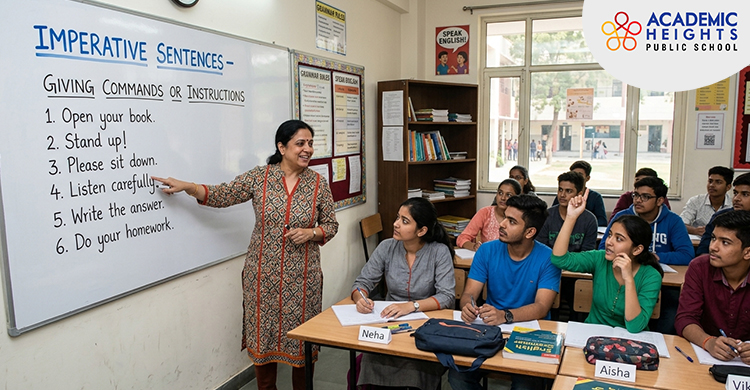
Imperative sentences are sentences which give or direct a command. They are a helpful part of English grammar sentence types in which we tell someone what to do—or not do—without needing to say “you” out loud. Basically, it’s your sentence saying, “Hey, do this!”
Examples:
- Remember to water the plants.
- Don’t eat all the cookies.
- Please pass the remote.
- Finish your homework now.
- Stop scrolling and pay attention.
4. Exclamatory Sentences – Strong Reactions

Exclamatory sentences are used to show strong emotions like excitement, surprise, joy, or anger! They make your writing and speech livelier and more energetic, and always end with an exclamation mark!
Examples:
- I can’t believe we won the game!
- What a beautiful sunset!
- That was the funniest movie ever!
- I am so happy to see you!
- The puppy is so tiny and cute!
Tips to Identify Different Types of Sentences
Learning the types of sentences in English is like figuring out who’s talking, asking, ordering, or shouting in a conversation. Let’s see how to spot them all!
Look at the Sentence Purpose
To understand a sentence, start by looking at its purpose. Are you telling, asking, commanding, or showing excitement?
Here are some examples of sentences for students: “Pass me the book” is an order, while “Wow, that cake looks amazing!” is an expression of excitement. See? Just notice what the sentence is trying to do!
Identify the Punctuation Marks
One of the easiest ways to figure out a sentence is by checking the punctuation marks.
A full stop tells you it’s a statement, like “I love ice cream.” A question mark is the nosy one, asking things like “Who ate the last cookie?” Exclamatory sentences express strong emotions or excitement, such as “That puppy is incredibly cute!”
Understand the Tone and Meaning
Every sentence has a tone and a meaning, which tell you how it feels and what it’s really trying to say. The ‘tone’ is like the sentence’s mood—happy, angry, excited, or curious—while the ‘meaning’ is the actual message.
Here is an example: ‘Can you help me with this?’ is a polite question, while ‘Hurry up, we’re late!’ is a command that shows urgency.
Common Mistakes Students Make While Using Sentence Types
Even when you understand the types of sentences in English, small mistakes can still happen. Now, let’s explore some common mistakes people tend to make.
Confusing Interrogative and Declarative Sentences
Sometimes students mix up interrogative and declarative sentences—and honestly, it happens to the best of us. You might write “You are coming” when you actually meant to ask “Are you coming?”
Just remember, if you are asking something, flip the words a bit and don’t forget the question mark. Otherwise, your question might sound like a very bossy statement!
Incorrect Use of Punctuation Marks
A common mistake with different kinds of sentences, like declarative, interrogative, imperative, and exclamatory, is using the wrong punctuation.
- Ending a question with a comma: Are you coming, → should be Are you coming?
- Forgetting an exclamation mark for excitement: Wow, that cake is huge. → should be Wow, that cake is huge!
Punctuation gives each sentence its personality, so always double-check, it can totally change the vibe!
Overusing Exclamatory Sentences
Overusing exclamatory sentences can make your writing feel too dramatic or exhausting.
For example, using a sentence like “I got ice cream!” once works well, but overusing similar exclamations can lessen their effect. For instance, adding lines like “It’s chocolate!” and “I love it!” can make the expression feel excessive.
Save the exclamations for the exciting stuff; everything doesn’t need to scream for attention!
Writing Imperative Sentences Without Clarity
Writing imperative sentences without clarity can confuse people. For example, “Do this” is vague—what’s ‘this’? “Pass me that”—uh, which one?
Always be specific in commands or instructions so everyone knows exactly what to do. For example, instead of “Pass me that,” try “Pass me the blue folder”, so no one ends up scratching their heads.
Why Students Should Learn the Types of Sentences
Discovering sentence types with examples can unlock the hidden patterns behind how we talk and write. Keep reading to see how these secrets make language more powerful and fun.
Improve Writing and Communication Skills
Knowing the different types of sentences can improve writing and communication skills.
For example, you can make a statement like “I finished my homework,” ask a question like “Can you help me?” or show a burst of happiness, for example, “I got ice cream!”
Using the right sentence type makes both conversations and writing clear, confident, and fun.
Strengthen English Grammar Knowledge
Want to strengthen your English grammar without pulling your hair out?
Start by knowing your sentence types—statements, questions, commands, and exclamations. Once you get the hang of them, punctuation stops looking scary, your writing makes sense, and you can finally sound like you know what you are saying!
Help in Reading and Language Understanding
Want to make reading and understanding language a whole lot easier? Get familiar with your sentence types!
Recognising statements, questions, commands, and exclamations makes following instructions or conversations much simpler. As George Orwell famously advised, the key to clear communication is a simple, direct structure.
Noticing sentence types is your first step to getting it right!
Conclusion
By now, you have probably spotted the types of sentences in English all around you—statements, questions, commands, and exclamations. Knowing them makes reading and writing much easier.
Plus, understanding them adds a little extra fun to writing and helps you express yourself exactly the way you mean to. Ready to level up your writing game? Dive into 6 Fun and Easy Ways to Boost Your Writing Skills and start turning your sentences into total superheroes today!