
Many students struggle to speak English, even though they can read and write it well. This gap between understanding a language and actually speaking it is very common, and it can be fixed. This blog will help you to learn practical, research-backed English speaking skills for students, showing exactly how students can improve their English, through daily practice, listening habits, vocabulary building, and simple confidence-building techniques that are appropriate at both, in the classroom as well as at home.
Why English Speaking Skills Matter for Students

English speaking skills for students aren’t just a common school subject; it’s a skill that students carry through different phases of their lives, from classroom discussions to their careers.
Confidence and Communication Skills
Interacting fluently in English lets students express their ideas clearly, participate actively in class, and engage with confidence with people around them. Having good communication skills helps in building a sense of self-assurance that extends well beyond the language itself, which shapes how a student shows up in every interaction. These are very useful tips for students to speak English fluently and communicate with greater confidence.
Academic and Future Benefits
Fluency in English helps in higher education, competitive exams, interviews, and almost all professional courses where the language is the primary source of communication at work. Moreover, students who speak the language confidently tend to participate more in classroom discussions and presentations, which, in turn, contributes to their all-round development apart from the English subject.
Practice Speaking English Every Day

More than any tips for students to speak English fluently, consistency matters more. Daily speaking, even less, builds fluency faster than occasional long speaking sessions.
Talk to Friends, Family, or Classmates
The easiest and most effective method is speaking in English with anyone you can find, be it a classmate at a break or a family member at home. Any conversation, however simple and uneventful it may be, will bring better results than any other type of training, as it engages your active use of language. This kind of English speaking practice for students makes regular conversation feel more natural. Regular conversation remains one of the best ways for students to learn English.
Describe Everyday Activities in English
Try to narrate everyday activities to yourself in English, like making tea, going to school, completing homework, etc. In fact, this is known as self-talk, and solo language practice builds the same mental pathways as real conversations. As a result, it helps students form sentences naturally without the fear of speaking in front of an actual audience.
Practice Speaking Without a Partner
As long as you can talk to yourself, shadow another English speaker (or simply record your own speech and play it back for listening practice), you can practice anytime, anywhere, even if you don’t have a conversation partner at hand. Using these simple methods, you can learn how to improve spoken English without a speaking partner.
Improve English Through Listening and Reading

Speaking any foreign tongue perfectly requires the acquisition of the basics of a given language. According to the famous input hypothesis proposed by Stephen Krashen, such a process takes place through exposing learners to “comprehensible input,” which is slightly challenging and understandable, with listening being the basic stage of all subsequent language stages. For learners wondering how students can improve their English speaking skills, listening to understandable English is a useful starting point.
Watch English Videos and Listen to Podcasts
Select content that is engaging for you and somewhat challenging (not too difficult). Such material could be TV series, YouTube channels, podcasts, or something that you would listen to regularly. The more you expose yourself to the natural speech patterns, intonation, colloquialisms, and other subtleties of English, the easier it will be to become accustomed to hearing it. Listening regularly is one of the best daily habits to improve English fluency.
Read Stories, Articles, and Books
Reading the sentences aloud strengthens pronunciation, builds vocabulary in context, and improves sentence rhythm. Choose topics in the niche that you genuinely like, for example, fiction, sports, or news. Engaging material is far easier to stick with than something chosen only because it seems “educational.” Reading aloud is another way to improve English speaking skills while strengthening pronunciation. Reading aloud can help students improve English speaking skills in context.
Learn Natural Expressions and Sentence Patterns
Beyond particular words, focus on how native speakers naturally phrase things, such as their common expressions, idioms, and sentence structures. Picking up such things from listening and reading helps speech sound more fluent and less like a word-by-word translation from another language, which is a natural cause.
Build Vocabulary and Pronunciation
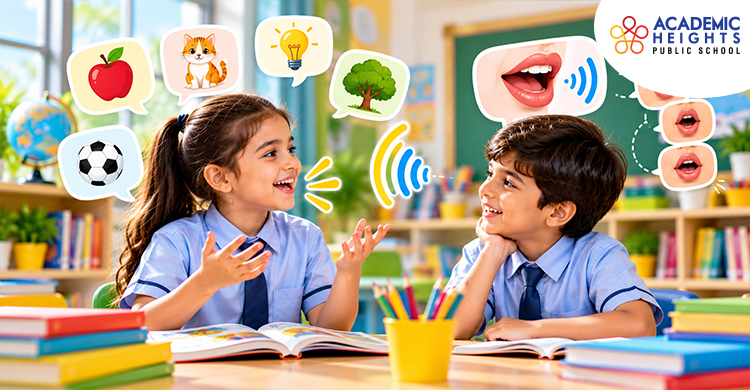
A wider vocabulary and clearer pronunciation result in fluency, giving students both more to say and the confidence to say clearly without any doubt. Clear pronunciation is an important part of English speaking skills for students.
Keep a Personal Vocabulary Notebook
Write down new words as you discover them, along with their meaning and an exemplary sentence. A personal notebook, built gradually, is far more memorable than a generic word list, because every entry is tied to something the student actually read or heard in their day-to-day life.
Use New Words in Daily Conversations
Learning a word isn’t enough when you haven’t used that word anywhere. It surely needs to be used. Deliberately work on the use of new vocabulary into conversations or self-talk within a day or two of learning it. This active use is what moves a word from passive recognition into natural, confident speech you can use in natural conversations.
Practice Pronunciation and Commonly Mispronounced Words
Certain English words are consistently mispronounced by students, like “schedule,” “February,” “vehicle,” etc. Practicing such words, ideally while recording and listening back, helps catch errors a student might not notice while speaking in the current moment.
Build Confidence Through Real Conversations

Knowing how students can build English confidence often matters more than knowing mere grammar rules. Confidence is what actually helps a student talk.
Start With Simple Conversations
Begin with short, low-pressure exchanges like greetings, simple questions, and basic descriptions. Fear of making mistakes is one of the biggest reasons students choose to stay silent, so starting with small decreases that pressure considerably and builds momentum for the longer conversations.
Practice in Pairs or Small Groups
Speaking to one or two people seems much less intimidating than addressing a whole class. Pair and small-group practice, used widely in language classrooms, gives students real speaking repetitions in an environment that feels safer and more forgiving of mistakes. These low-pressure conversations show how students can speak English more confidently in a supportive setting.
Don’t Be Afraid of Making Mistakes
Mistakes are an inevitable part of the learning process, which does not necessarily mean that they can be eliminated. When communicating in a foreign language, one is bound to err, but it happens mostly in adverse conditions, when there is a threat and shame. Hence, from the perspective of training, mistakes should be normalized as a phenomenon, which does not bring any embarrassment to the person who makes them.
Use Digital Tools for Regular Practice

Technology has made English speaking practice for students more accessible than ever, especially for students without the need for a conversation partner.
Language-Learning Apps
Apps built for speaking practice, with pronunciation feedback, guided conversations, or AI-based dialogue give students structured, repeatable practice outside classes. They work best as a daily supplement to real conversation, not a replacement for it.
Online Videos and Learning Resources
Despite the formal apps, free resources like YouTube channels for English learners, podcasts, and online dictionaries with audio pronunciation give students flexible ways to keep learning on their own schedule, according to the school, and around other commitments.
Record and Review Your Own Speaking
Recording yourself speaking and listening back is one of the fastest ways to catch pronunciation errors, awkward pauses, or overused filler words. Self-review builds awareness that simply speaking out loud, without listening back, will never work.
Make English Speaking a Daily Habit

Improve English speaking skills fastest by treating practice as a habit, not an occasional task done just before any test.
Set Small and Realistic Goals
Rather than vague goals like “get fluent,” set specific, achievable ones like “speak for five minutes today” or “use three new words in conversation.” Small, consistent goals are far easier to achieve than big, overexhausting ones.
Track Your Progress
Keep a simple log of what was practised each day, or revisit old recordings every few weeks to notice improvement. Seeing real progress, even in small bits, is one of the strongest motivations to keep going.
Practice Consistently Instead of Cramming
Twenty minutes of daily practice builds fluency far more effectively than a long session once a week. Consistency trains the brain to access English naturally, while cramming tends to fade quickly once the pressure of a test or deadline passes. This illustrates how regular practice improves English speaking and it makes using the language more familiar and automatic.
How Schools Can Improve Students’ English Speaking Skills

Classrooms play a major role in turning individual effort into real, practised fluency; structured opportunities to speak matter as much as motivation. Schools can complement home routines by creating such opportunities to practice English speaking skills for students.
Encourage Classroom Discussions
The students can gain a lot from holding regular class discussions, even if they are brief. By working on spoken communication in day-to-day classes, instead of reserving it for set speaking exercises, students learn to view English as a living tool that they can engage with.
Use Debates, Presentations, and Role-Play
Classroom speaking activities tend to indicate that debates and role-playing can be much more effective than passive activities in terms of increasing fluency, pronunciation, and boosting general confidence. This is mostly true because such activities demand independent thinking and organizing one’s ideas.
Create Opportunities for Confident Communication
Other than formal activities, schools that implement these opportunities to a large extent (e.g. assemblies, group work, or designated time for discussion) will cultivate confidence in speaking in front of others, which, as a result, will be much less daunting to students than if they were to only be presented with this skill when it is formally assessed.
Frequently Asked Questions
• Practice speaking English every day in any form, such as conversations, self-talk, or shadowing to learn new words.
• Listening to English material daily and speaking out loud without hesitation will help build your confidence and improve your speaking.
• Pay attention to how native English speakers talk and practice speaking the words that are difficult to pronounce.
• Listening to English content regularly and recording your voice while speaking will help you identify areas of improvement.
• Shadowing exercises are an excellent way to learn and practice English pronunciation.
• Make a personal word book and add new words to it. Read more and more books on topics that interest you to learn more words.
• Use new words in your conversations after learning them to add them to your active vocabulary.
• Start preparing short conversations and practice them daily. You can practice speaking with a friend or in a small group instead of addressing a larger audience.
• Remember that making mistakes is a natural and unavoidable part of the learning process.
Language apps are helpful for building speaking skills as they provide interactive speaking exercises on a daily basis. You may also choose apps that allow you to record and review your voice to improve your accent, intonation, and pronunciation. However, it is essential to complement app-based exercises with actual speaking practice and real speaking opportunities.
• You can practice self-talk or shadowing exercises regularly to improve your English speaking skills.
• Additionally, recording and reviewing your voice while speaking is a helpful tool to identify areas of improvement. These methods do not require a speaking partner and can be done anywhere and anytime.
Schools like Academic Heights Public School focus on building students’ speaking skills in their classrooms. They organize discussions, debate competitions, presentations, role-play activities, etc., along with qualified and experienced English teachers who encourage students to speak English and help them become confident English speakers.
Conclusion
Developing the ability to speak English is not necessarily about learning the exact rules of grammar before engaging in a conversation. This skill is rather a result of daily practice and accumulated experience. A student who wants to become fluent in English should be curious about the language and brave enough to make mistakes in order to get closer to the goal of flawless communication.
The ability to speak English is a skill that can be developed by everyone ready to practice enough and build the necessary habits. Having trained their conversational skills in different settings, students will be confident in communicating with real people on the streets. In short, English speaking practice for students comes down to consistency, useful feedback, and the courage to keep speaking.
You may also like : –
How to Help Students Who Fear Asking Questions in Class
Why Adaptability Skills For Students Matter More Than Ever
How Schools Help Students Develop Real-World Skills Beyond Academics
How To Improve Reading Speed and Comprehension?
Harmful Effects of Smartphones on Students
Why Holistic Child Development Matters Beyond Academics