
Many students crack their Board exams easily but face challenges in competitive exams like JEE, NEET, and CUET. The gap isn’t about intelligence; it’s about preparation. If you want to understand the CBSE curriculum for competitive exams, then you’ve to begin with a genuine question, “Is school able to build the foundation required to crack any competitive exam or do I’ve to do it from somewhere else?” The answer is secretly hidden between these questions. CBSE indeed builds a strong academic framework through conceptual learning, NCERT-based fundamentals, problem-solving practice, and disciplined study habits, but an add-on of exam-specific preparation still matters. This blog exactly targets that gap.
How CBSE Builds Strong Conceptual Understanding

The CBSE curriculum for competitive exams starts with strong conceptual learning. Competitive exams are never just about memorization. Competitive exams work for those students who can understand the concepts clearly and can also apply them in unfamiliar problems, and that’s the gap where the CBSE curriculum and conceptual learning start to matter.
Why Conceptual Clarity Matters for Competitive Exams
Together, CBSE curriculum and conceptual learning help students approach unfamiliar problems with greater confidence. Be it NEET or JEE, both require conceptual clarity, problem-solving, and reasoning ability instead of rote recall. A student who has memorized theories will struggle the moment a question is about the application of a specific formula that is not given in the textbook. Conceptual clarity is the only thing required to identify any problem, even if it is in a different pattern, and that is what the CBSE Curriculum for Competitive Exams builds when studied properly.
How CBSE Moves Beyond Rote Learning
This is where the CBSE curriculum and conceptual learning work together. CBSE is trying to move towards application-based questions, case studies, and higher-order thinking skills rather than pure memorization. Teachers have to explain the “why” behind a concept, not just the “what.” Competitive exams test your ability to question assumptions, a skill built over years.
Role of NCERT in Competitive Exam Preparation

We can’t separate CBSE and NCERT-based learning, as every CBSE-affiliated school follows the NCERT textbooks from class 1st to 12th.
Building Strong Fundamentals Through NCERT
The CBSE curriculum for competitive exams also benefits from a strong NCERT foundation. Strong CBSE and NCERT based learning also makes the foundation easier to revise. Most of the NEET and JEE questions are generally based on the NCERT concepts. That’s why NCERT plays a major role in preparing for the competitive exams. Students who rely on the NCERT books create a strong conceptual base, which is better than studying from somewhere else and from scratch too.
Using NCERT for Effective Revision
Strong CBSE and NCERT based learning also makes revision more focused. Due to its concise and concept-focused approach, NCERT works better as a revision tool. During the last phase of preparation, just before the exam, you can easily go through the NCERT diagrams, definitions, examples, and in-text questions instead of flipping through thick reference books. The CBSE Curriculum for Competitive Exams helps you prepare within the scheduled time.
How CBSE Supports Competitive Exam Preparation
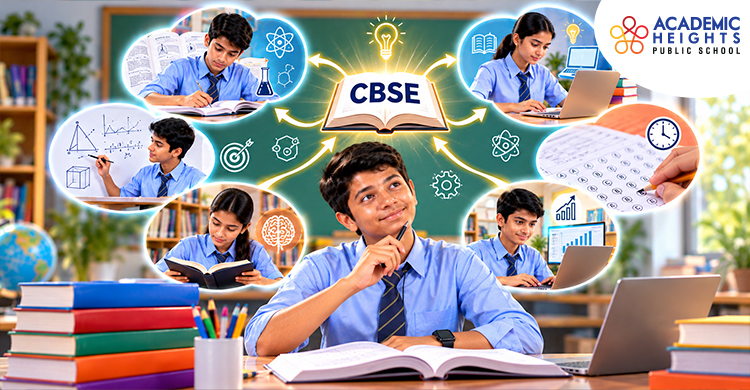
School learning and entrance exams are not connected randomly; rather, it’s the overlapping of the systems that results in how CBSE supports competitive exam preparation.
Foundation for JEE, NEET and Other Entrance Exams
This connection makes CBSE board and entrance exam preparation more practical for students. This makes CBSE board and entrance exam preparation more connected to the demands of entrance exams. Because CBSE follows the exact structure and pattern of NCERT, we can say that there is no major gap between board exam preparation and entrance exams like JEE or NEET. NCERT builds a strong base for Physics, Chemistry, Biology, and Mathematics taught in class 11th and 12th, and this is what competitive exams generally expect from the students. So there is no need to cover the syllabus from any different resource.
Application-Based Learning for Better Understanding
Apart from JEE and NEET, the overlap extends further. CUET’s domain-based syllabus is completely based on the class 12th NCERT topics. CLAT’s quantitative techniques section is still based on the class 10th Mathematics NCERT. The learning we get in schools, which is built on applications, pays off across more exams than students often realize.
CBSE Curriculum and Competitive Exam Preparation

We need to be very specific about what schools can actually do and what they cannot so as to understand the practical benefits of CBSE curriculum.
What CBSE Curriculum Provides
CBSE provides learners with conceptual grounding, structured progression from basic to advanced topics, and regular exposure to application-based questions. These are among the key benefits of CBSE curriculum for students building their academic foundation. While this groundwork is highly valuable, it does not include specific exam training.
Why Additional Practice Still Matters
The learning we get from CBSE and NCERT doesn’t include problem-solving speed under exam pressure, exam-specific question patterns or the sheer volume of questions practice that JEE, NEET, CLAT and CUET expect.
How CBSE Bridges That Gap
Many CBSE schools now run internal tests aligned with JEE and NEET patterns, offer doubt-clearing sessions, and integrate aptitude-building activities into the regular day schedule. This contributes to CBSE exam readiness for students. Though it doesn’t mean that CBSE has replaced dedicated exam coaching, it has bridged the board-level learning and entrance-exam demands.
How CBSE Develops Problem-Solving Skills

Apart from concepts, entrance exams also focus on how quickly and accurately a student can solve the problem, which is again a skill that CBSE tries to develop before Class 12 and an important part of CBSE exam readiness for students.
Numerical and Case-Based Learning
CBSE question exercises increasingly include numerical problems, case-based problems, and data interpretation, especially in Mathematics and Science. This structure is similar to the format of CUET’s Quantitative Techniques and JEE’s numerical-answer problems, making students comfortable early with how CBSE improves problem-solving and adaptability skills in students.
Building Speed and Accuracy Through Practice
Regular classroom tests, homework problems, and periodic assessments prepare students to solve problems in the given time frames. This habit, when repeated over years, builds the speed and accuracy that competitive exams expect from the students, though the pace of a 60-minute CUET paper or a 3-hour JEE paper still demands overall practice.
Regular Assessments and Time Management Build Exam Readiness
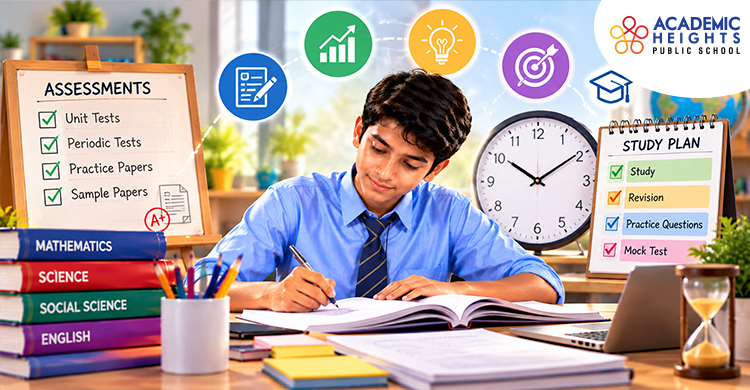
If a student is ready for a CBSE exam, syllabus covering is not a single thing to focus; it’s about showing consistency in your study under a clock.
Tests and Assessments for Consistent Practice
CBSE’s framework of periodic tests, unit tests, and term-wise exams help students to stay in regular contact with exam conditions. This consistency should be prioritized over any single marksheet. It builds a familiar relationship with the rhythm of preparation, revision, and assessment.
Building Time Management and Exam Discipline
Appearing in multiple board-pattern exams naturally teaches students how the CBSE curriculum supports time management skills like pacing answers, allocating marks per minute, and staying calm through fixed-duration exams. These are transferable skills, meaning they’re directly useful when facing the 60-minute-per-subject pattern of CUET or the negative marking in any competitive exam.
How Parents Can Choose the Right CBSE School for Competitive Exam Readiness

It’s not always true that CBSE-affiliated schools excel in delivering the required foundation. So, it makes school selection from the competitive exam’s perspective a very important task for a parent.
Strong Academic Foundation and Experienced Teachers
Parents can evaluate each CBSE school for JEE NEET preparation on both teaching quality and exam support. A CBSE school for JEE NEET preparation should therefore be evaluated on both teaching quality and exam support. The best CBSE school for competitive exams should offer a strong foundation in the CBSE Curriculum for Competitive Exams along with appropriate exam-oriented support. Prioritize those schools where the teachers use real-world and practical examples to teach complex concepts, instead of just completing the syllabus. Find out if the school conducts JEE/NEET or CUET pattern mock tests, and if the faculty have experience in guiding students to crack these exams.
Support for Academic and Overall Student Development
The best CBSE school for competitive exams should offer both a strong academic foundation and meaningful exam-oriented support. Generally, the CBSE curriculum prescribes extra-curricular activities, too, because it nurtures life skills and self-esteem alongside academics. An ideal school balances rigorous academics with sports and arts, and mentoring tends to produce students who handle exam pressure without a burnout. It all matters just as much as the marksheet.
Common Mistakes CBSE Students Should Avoid

Sometimes, even with a strong curriculum, students derail their own preparation in various ways. These are the real mistakes CBSE students make in preparing for exams.
Relying Only on School Textbooks
NCERT builds the foundation, not the final step. Students who never go beyond the school textbooks generally struggle with the range and difficulty of questions that are expected in the competitive exams. Reference books, PYQs, and mock tests are non-negotiable add-ons.
Memorizing Instead of Understanding Concepts
Some students take NCERT in the wrong way by considering it the only book to memorize for cracking any exam. When a competitive exam asks a familiar concept in a twisted way, memorization doesn’t work. In that situation, only your understanding can save you, which is why the CBSE Curriculum for Competitive Exams has to be studied for concepts, not just facts.
Ignoring Regular Practice and Revision
Following the right Class 9th Admission Tips for Parents and Students can help students build a strong academic foundation early. Starting serious preparation in Class 12 only rarely works out, as Class 9 and Class 10 concepts frequently appear in the foundation of JEE, NEET, and CUET. So, students who skip regular revision sessions must waste time relearning the basics under exam pressure instead of mastering the advanced topics. This is why a strong grip on the CBSE Curriculum for Competitive Exams matters from the early years.
Frequently Asked Questions
It helps in developing conceptual clarity, follows the NCERT framework that most competitive exams draw from, and provides students with application-based and case-based questions from the initial learning. It’s a strong base, though not a complete substitute for dedicated exam-specific learning.
Yes, a big portion of questions in JEE and NEET are directly based on the NCERT syllabus that the CBSE curriculum teaches, giving students a good start. An add-on of PYQs and time-based mocks is still needed to manage the exams’ difficulty and pace.
NCERT textbooks develop the basis for NEET, a big part of JEE, and the whole domain-specific section of CUET. Studying NCERT thoroughly develops the basis these exams expect from students.
Firstly, learn and understand the syllabus of NCERT completely, then refer to reference material, subject-wise practice questions and time-based mocks. Start this process from the initial learning phase, like Class 9 or 10, instead of waiting until Class 12.
Regular tests, numerical and case-based questions, and fixed-time examinations train the students to solve problems precisely with constraints, which is perfect for the most competitive exams, generally.
A good CBSE school with experienced faculty, exam-like mocks, and a balance of academics and extracurricular activities develops a child holistically, which any competitive exam demands. Combined with a strong grip on the CBSE Curriculum for Competitive Exams, this approach prepares students for both board exams and entrance tests.
Conclusion
Overall, the CBSE curriculum for competitive exams provides a strong academic base, while exam-specific practice remains important. CBSE doesn’t guarantee excellent performance in JEE, NEET, CUET, or CLAT, but no school board can guarantee that. What it offers is a genuinely strong conceptual foundation at the early stage, like NCERT-based basics, regular assessment, and disciplined study habits. Students who develop their base with focus and exam-specific practice perform exceptionally well in competitive exams.
You may also like :-
Best Free AI Tools for Homework Every Student Needs
Harmful Effects of Smartphones on Students
Why the Right Teachers Matter More Than the Right Curriculum