
Ask any student what part of maths class makes them nervous, and word problems usually top the list. Numbers alone feel manageable, but the moment a question turns into a paragraph, confidence dips. Why do maths word problems feel so difficult even for children who are otherwise comfortable with calculations? The answer lies not in maths itself, but in the extra layer of skills word problems demand: reading, interpreting, and translating language into numbers before any actual solving begins.
What Makes Maths Word Problems Different?
Understanding why maths word problems are difficult starts with recognising that they are never just about numbers.
A word problem is really two problems stacked together—a language puzzle first, then a maths puzzle. Children must decode what is being asked before they can even begin solving maths word problems, and this hidden first step is where most of the struggle actually begins.
Understanding the Difference Between Direct Questions and Word Problems
A direct question like “What is 16 + 57?” needs only calculation. A word problem hides the same numbers inside a story, forcing students to identify what to add, subtract, or compare. This shift is central to difficulty understanding maths questions, since the operation is never handed over directly—it has to be found.
Why Word Problems Require More Than Calculation
Solving a word problem calls on maths problem-solving skills far beyond arithmetic, which means spotting relevant details, ignoring distractions, and choosing the right method. Why students struggle with word problems often has little to do with weak calculation and everything to do with this missing bridge between comprehension and computation.
The Role of Reading and Interpretation
Strong reading comprehension is often the real gatekeeper here. A child who misreads “how many more” as “how many in total” will get the maths wrong even with perfect calculation skills. This is exactly how to understand word problems correctly, by slowing down and reading with intention before reaching for a pencil.
Reading comprehension plays a vital role in solving mathematical word problems. Research from the National Center for Education Statistics (NCES) highlights the close relationship between reading proficiency and academic achievement across subjects, including mathematics.
Why Do Students Struggle with Maths Word Problems?
Beyond reading and interpretation, several other roadblocks quietly work together. Understanding why students struggle with word problems means looking closely at each one rather than treating it as a single, simple issue.
Difficulty Understanding the Question
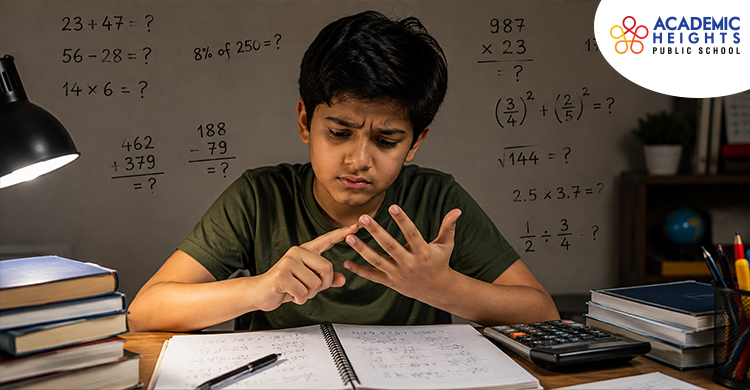
Many students read a word problem quickly and miss its actual intent, leading to a genuine difficulty understanding maths questions. Without pausing to identify what is really being asked, they may apply the wrong operation entirely, even when their calculation skills are perfectly sound.
Students can also use AI tools for math homework to get step-by-step explanations and practise solving equations, while focusing on understanding the method rather than copying answers.
Trouble Identifying Important Information
Word problems often mix useful numbers with irrelevant details designed to test focus. Students struggling with critical thinking find it hard to filter out the noise, mistaking every number in a paragraph as necessary to solve maths word problems correctly.
Students who develop strong critical thinking skills are better able to identify relevant information, ignoring distractions like smart phones , and choose the correct approach to solve word problems.
Fear of Complex Calculations
Once a question feels wordy or layered, many students assume the maths itself must be complicated. This fear builds before they’ve even attempted the problem, blocking clear logical thinking and making straightforward calculations feel far harder than they truly are.
Lack of Confidence in Problem Solving
Repeated mistakes with word problems can chip away at self-belief over time. Weak maths problem-solving skills confidence often becomes the real barrier, causing students to give up early instead of applying problem-solving strategies they already know.
Building confidence comes from applying concepts in practical situations and developing real-world skills beyond academics through regular practice and logical thinking.
Common Mistakes Students Make in Word Problems
Even students who are strong at calculations often struggle when maths word problems feel so difficult to decode. The gap isn’t in numbers; it’s in how the question is read and understood. Below are the most common mistakes that quietly derail correct answers.
Reading Too Quickly
One of the biggest reasons why maths word problems are difficult is rushed reading. Students often skim through the question, catching only numbers and skipping the context that connects them. This leads to misunderstanding what is actually being asked. Slowing down and reading–once for the story, once for the numbers dramatically improves accuracy and builds stronger reading comprehension for maths.
Many careless errors can be avoided by following strategies that help students stop making silly mistakes in exams, such as reading every question carefully before solving it.
Ignoring Key Details
Word problems often hide small but crucial details—units, time frames, or conditions like “twice as many” or “remaining.” Skipping these leads to common mistakes in maths word problems that have nothing to do with calculation ability. Training students to underline or circle important details before solving encourages careful reading and sharpens critical thinking, making the actual maths far easier to apply correctly.
Choosing the Wrong Mathematical Operation
Many students struggle not with the maths itself, but with figuring out which operation to use. This is a core reason why students struggle with word problems—the question doesn’t say “add” or “divide” outright. Developing strong maths problem-solving skills means learning to translate phrases like “in total” or “shared equally” into the correct operation, rather than guessing based on habit.
Failing to Check the Final Answer
Even after solving correctly, many students skip the final step: checking if the answer actually makes sense. This is a simple yet powerful part of solving maths word problems with confidence. Asking “does this number fit the situation?” builds logical thinking and catches careless errors like a bag having “3.5 apples” —before they cost marks in an exam.
How Reading Skills Affect Maths Performance
Maths and language are more connected than most people realise. The answer of how to understand word problems often depends less on formulas and more on how well a student reads, interprets, and processes written information, making reading skill a hidden foundation of maths performance.
Understanding Mathematical Language
Words like “sum,” “difference,” “product,” and “less than” carry precise mathematical meaning. Students who aren’t fluent in this vocabulary often misread simple questions, which is a major reason why maths word problems feel so difficult in the first place. Strengthening mathematical reasoning starts with treating maths vocabulary as seriously as any other subject’s terminology, since one misunderstood word can change the entire answer.
Recognizing Keywords and Clues
Certain words act as signals for which operation to use—”altogether” often means addition, while “each” may point to division. Teaching students to actively spot these clues is one of the most effective tips for solving maths word problems. This skill turns confusing paragraphs into clear, solvable steps and reduces the guesswork that usually leads to wrong answers.
Turning Words into Equations
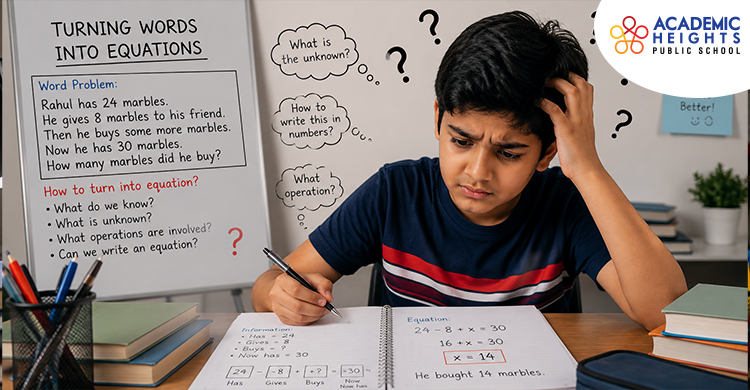
The real skill behind how to solve maths word problems easily is translation—converting a written scenario into a mathematical equation. This requires combining reading comprehension, maths concepts, and calculation skills together. Practising this translation step regularly, separately from solving, helps students build confidence and directly supports how to improve maths problem-solving skills over time through consistent, structured practice.
Simple Steps to Solve Maths Word Problems
Solving maths word problems doesn’t have to feel scary. If you follow a few simple steps every time, even tricky questions become easy to handle. Let’s look at these steps one by one.
Read the Question Carefully
The first step in how to solve maths word problems easily is slow, careful reading. Don’t jump straight to the numbers. Read the whole question at least twice so you understand the full story. Many mistakes happen simply because students rush and miss small but important words, leading to wrong answers even when their maths is correct.
Identify What Is Given
Next, find out what information the question has already given you. Write down all the numbers, facts, and details mentioned. This is one of the easiest tips for solving maths word problems, because once you separate the given information clearly, the problem feels much smaller and far less confusing to work through.
Determine What Needs to Be Found
Now ask yourself, “What is the question actually asking me to find?” This step is important because many students solve for the wrong thing by mistake. Understanding this clearly builds strong problem-solving strategies, since knowing your goal helps you pick the right numbers and the right steps to reach the correct final answer.
Choose the Correct Method
Once you know what’s given and what’s needed, decide whether you should add, subtract, multiply, or divide. This step often causes common mistakes in maths word problems, so think about how the numbers relate to each other. Picking the right method here makes the actual calculation part quick, simple, and stress-free.
Verify the Answer
Finally, check your answer to the question. Does it make sense? If a question asks about people, your answer shouldn’t be a fraction. This last step is key to how to improve maths problem-solving skills, as it helps catch small errors before they turn into bigger mistakes in your final result.
Strategies to Improve Maths Problem-Solving Skills
Getting better at maths word problems isn’t about being naturally “good” at maths. It’s about using the right strategies again and again until they become second nature. Here are some simple ways to build maths problem-solving skills over time.
Practice Similar Question Types
One of the best ways to improve is by practising the same type of question repeatedly. This helps you notice patterns and understand how to solve maths word problems easily, since similar problems often use similar steps. Over time, your brain starts recognising the structure of a question, making even new problems feel familiar and far less confusing.
Draw Diagrams and Visual Aids
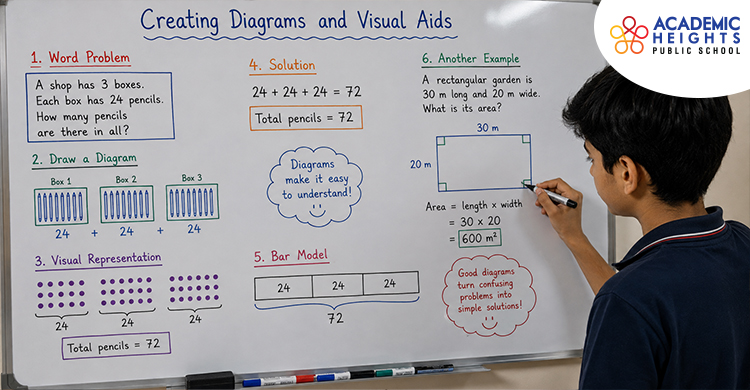
Sometimes words are confusing, but pictures make things clear. Drawing a simple diagram, box, or number line can help you understand what a question is really asking. This is a powerful tip for solving maths word problems, especially for younger students, because it turns confusing sentences into something you can actually see and understand easily.
Break Large Problems into Smaller Parts
Big word problems can feel overwhelming when you look at them all at once. Instead, break the question into smaller, simpler parts and solve one part at a time. This is a key part of maths problem-solving skills, as smaller steps feel manageable and reduce the confusion that usually causes common mistakes in maths word problems.
Think Step by Step
Avoid jumping straight to an answer. Instead, work through the problem calmly, one step at a time. This builds strong logical thinking and mathematical reasoning, helping you stay organised. Thinking step by step also makes it much easier to spot mistakes early, rather than realising something is wrong only at the very end.
A thinking-based learning approach encourages students to analyse each step carefully instead of rushing to the final answer.
How Teachers and Parents Can Help
Students don’t build strong math skills alone. With the right support at home and school, why students struggle with word problems can be solved much faster and with far less stress.
Encouraging Logical Thinking
Teachers and parents can help by asking simple questions like “What do you think we should do first?” instead of giving direct answers. This encourages them to think about maths concepts and logical thinking, allowing students to reason through problems themselves. Over time, this builds independence and strengthens their overall mathematical reasoning skills.
Making Maths Relevant to Daily Life
Connecting maths to everyday situations, like shopping, cooking, or travel, makes it easier to understand. This supports real-world maths applications and helps students see why maths actually matters. When numbers relate to real life, questions feel less abstract and much easier to understand and solve.
Building Confidence Through Practice
Regular practice, patience, and encouragement help students feel less anxious about maths. Celebrating small wins builds confidence and reduces fear around difficult questions. This steady support plays a big role in how to improve maths problem-solving skills, turning maths from a stressful subject into one students feel capable of handling.
Strong concentration also plays an important role, and improving the attention span in school kids helps students stay focused while solving lengthy word problems.
Benefits of Mastering Maths Word Problems
Once students overcome the confusion around word problems, the rewards go far beyond just better exam scores. Mastering this skill builds abilities that help in maths and in everyday life.
Improved Critical Thinking Skills
Solving word problems regularly trains the brain to think logically and analyse information carefully. Students learn to look beyond the surface of a question and understand what it truly means. This strengthens critical thinking and mathematical reasoning, skills that help not just in maths class but in every subject that requires careful, structured thinking.
Better Academic Performance
When students learn how to understand word problems, their overall maths performance improves significantly. They stop losing marks due to misreading questions and start solving confidently. This directly boosts exam results and reduces the stress around maths tests, since a big part of struggling with maths is simply struggling with the wording of questions.
Students who regularly practise problem-solving are less likely to forget everything they study before exams, as consistent revision strengthens understanding and recall.
Stronger Real-World Problem-Solving Ability
Maths word problems mirror real-life situations—budgeting, measuring, planning, and comparing. Mastering them builds strong real-world maths applications, helping students handle everyday decisions with numbers more confidently. This skill stays useful well beyond school, supporting practical thinking in daily tasks like shopping, cooking, travelling, or managing money wisely.

FAQs (Frequently Asked Questions)
1. Why are maths word problems harder than regular maths questions?
Word problems require reading and understanding a situation before any calculation begins. This mix of language and maths is why maths word problems feel so difficult, since students must first translate words into numbers before solving anything.
2. How can students solve word problems more easily?
Following simple steps—reading carefully, identifying given information, and choosing the right method—makes solving maths word problems much easier. Practising regularly also helps students recognise patterns and solve similar questions faster and with more confidence.
3. Why do students struggle with maths problem solving?
Many students struggle because they focus only on numbers and skip understanding the actual question. This is a major reason why students struggle with word problems, as weak reading comprehension often causes more errors than weak calculation skills.
4. What are the common mistakes in maths word problems?
Some common mistakes in maths word problems include reading too quickly, missing key details, picking the wrong operation, and not checking the final answer. Avoiding these small mistakes can greatly improve accuracy and overall maths performance.
5. How can parents help children with math word problems?
Parents can help by asking guiding questions instead of giving direct answers, encouraging logical thinking, and relating maths to daily life situations. This support builds confidence and steadily improves a child’s maths problem-solving skills over time.
Conclusion
Maths word problems feel so difficult mainly because they combine reading, understanding, and calculation all at once. But with the right approach of careful reading, identifying key details, and practising step-by-step methods, difficulty fades quickly. By building strong maths problem-solving skills through consistent practice, students can turn confusing word problems into simple, solvable questions, gaining both confidence and better results in maths over time.