
Trigonometry can feel confusing because there are many formulas that look similar but are used in different situations. Many students know the formulas yet struggle to decide which one fits a particular question. Learning how to choose the right trigonometric formula is more important than memorizing it. By understanding the problem, recognizing the given information, and identifying the required result, one can solve trigonometry questions faster, improve accuracy, and build stronger mathematical reasoning and problem-solving skills.
Why Students Struggle to Choose the Right Formula
Many students understand basic sin, cos, and tan values but feel confused while solving complex questions. The biggest challenge is deciding which trigonometric formula to use. Since trigonometry includes different identities, ratios, and angles, students often end up applying the wrong formula, which makes even simple problems difficult.
Exploring the reasons behind these issues helps create better learning strategies. Let’s look at the most common obstacles that prevent students from choosing the correct trigonometric formula.
Memorizing Without Understanding
Simply memorizing trigonometric identities and formulas without understanding their purpose creates confusion when solving complex questions. Students often recall several formulas at once but cannot identify the most suitable one. Understanding the logic behind each identity makes choosing formulas in trigonometry easier and improves accuracy while solving questions.
Instead of rote learning, students should develop thinking-based learning habits to understand concepts and apply formulas with confidence.
Confusion Between Multiple Formulas
Since several trigonometric identities may apply to the same problem, choosing the correct one can often be confusing. The struggle to decide between angle formulas, double-angle identities, and basic trigonometric ratios is real. Identifying the given values and the required answer helps narrow down the correct formula and simplifies the solution process.
Common Mistakes During Problem Solving
Common mistakes include applying the wrong identity, ignoring angle conditions, or mixing up sin, cos, and tan relationships. These errors often occur because students rush into calculations without analyzing the question. Careful reading and understanding of when to use trigonometric formulas can significantly improve accuracy.
Building strong critical thinking skills helps students analyse problems carefully before selecting a trigonometric formula.
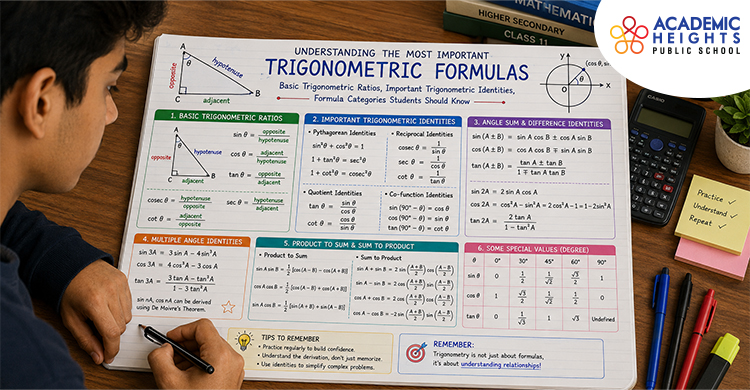
Understanding the Most Important Trigonometric Formulas
Before learning how to choose the right trigonometric formula, students should understand the purpose of the most commonly used formulas. Instead of trying to memorize everything, rather understand the logic behind it. This makes trigonometric formula selection easier and improves confidence while solving different types of questions.
Basic Trigonometric Ratios
The basic trigonometric ratios—sin, cos, tan- are the foundation of trigonometry. They are mainly used in right triangle problems to find unknown sides or angles. Understanding the relationship between these ratios helps students recognize when to use trigonometric formulas in simple or advanced questions. The basic trigonometric ratios are given below:
- sin θ = Opposite/Hypotenuse (Perpendicular/Hypotenuse)
- cos θ = Adjacent/Hypotenuse (Base/Hypotenuse)
- tan θ = Perpendicular/Base
- sec θ = Hypotenuse/Base
- cosec θ = Hypotenuse/Perpendicular
- cot θ = Base/Perpendicular
Important Trigonometric Identities
Beyond the basic ratios, trigonometric identities let you simplify or rearrange expressions rather than solve directly for a side. These include relationships like the Pythagorean identity and angle sum formulas, and they’re essential once questions move past simple triangles into algebraic manipulation. One of the most important and widely used formulas in trigonometry is the Pythagorean Identity.
sin2θ + cos2θ = 1
tan2θ + 1 = sec2θ
cot2θ + 1 = cosec2θ
Formula Categories Students Should Know
Students should organize formulas into categories such as basic ratios, identities, angle formulas, double-angle formulas, and transformation formulas. This approach simplifies formula selection in trigonometry because each category serves a specific purpose. Like:
- Fundamental Ratios
- Basic Reciprocal & Quotient Identities
- The Core Pythagorean Identity
Grouping formulas also improves trigonometry problem-solving and reduces confusion during exams.
How to Identify Which Formula a Question Needs
Many students know the formulas but still struggle because they cannot identify the right one. Carefully reading the question before you begin is the key to finding the correct solution. Understanding the given information and the required answer makes how to solve trigonometry questions much simpler.
Example-
QUESTION: A right triangle has an angle of 30° and a hypotenuse of 12 cm. Find the opposite side.
Reading the Given Information Carefully
Start by identifying what values are already provided. Check whether the question gives angles, side lengths, or specific trigonometric ratios. Careful reading helps you understand how to know which trigonometric formula to use before beginning the calculations.
Improving your attention span in school kids can help students avoid missing important details in mathematics questions.
STEP 1: Identifying the given information in the above question (at the beginning of this section):
- Angle = 30°
- Hypotenuse = 12 cm
Finding What Needs to Be Calculated
Next, identify exactly what the question asks you to find. Whether it’s an angle, a side, or an identity proof, knowing the goal helps avoid common mistakes in trigonometry questions and keeps your solution focused.
STEP 2: What needs to be calculated in the given question?
- Opposite side (perpendicular), which is unknown
Matching Data with the Correct Formula
Finally, compare the given information with the available formulas. If the question involves sin, cos, tan, identities, or angle calculations, choose the formula that directly connects the known values with the unknown. This simple habit strengthens mathematical reasoning, improves problem-solving skills, and is one of the best tips for solving trigonometry problems.
STEP 3: Since the given question involves the Opposite side and the Hypotenuse, use the Sine (SOH) formula:
Sin300 = Opposite (P) /12
½ = P / 12
12 / 2 = P
P = 6
When to Use Sin, Cos, and Tan
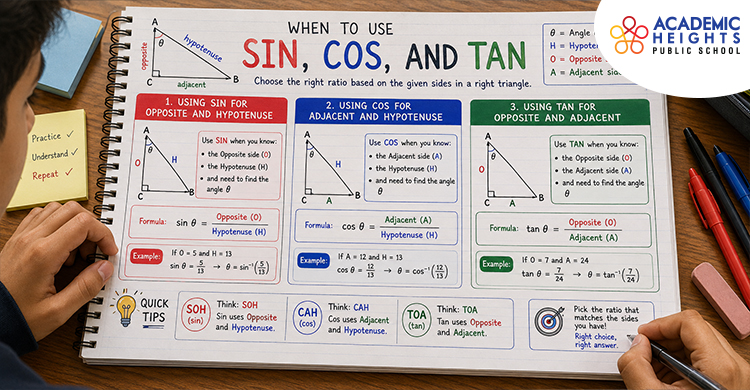
Choosing the right trigonometric formula is often where students get stuck, even when they know the identities well. The trick isn’t memorising more formulas; it’s learning to read a triangle correctly and match the known values to the right ratio.
Using Sin for Opposite and Hypotenuse
Sin comes into play whenever a question gives you, or asks you to find, the side opposite the angle and the hypotenuse. If both these sides are involved and no adjacent side is mentioned, sin is almost always your formula.
sin = opposite / hypotenuse
sin 𝝧 = P / H
Using Cos for Adjacent and Hypotenuse
Cos follows a similar principle but uses the adjacent side rather than the opposite side. Whenever a problem connects the side next to the angle with the hypotenuse, cos is the ratio you need–no guesswork required.
cos = base / hypotenuse
cos 𝝧 = B / H
Using Tan for Opposite and Adjacent
Use tan whenever the hypotenuse is not part of the given information. If a question only gives you the opposite and adjacent sides, tan is the natural choice, since it relates these two directly.
tan = perpendicular / base
tan 𝝧 = P / B
Simple Tricks to Choose the Right Trigonometric Formula
Learning to identify the sides is only the beginning. With the right habits, choosing the appropriate trigonometric formula becomes faster and more accurate.
Start with Known Values
Before selecting a formula, identify all the information provided, such as the angle, the side lengths, or both. This simple habit narrows your options immediately, since each trigonometric ratio only works with a specific pair of known and unknown values. Skipping this step is where most errors begin.
Look for Relationships Between Sides
Once you know what’s given, ask which two sides are actually connected in the problem. Ask yourself whether the question involves the hypotenuse and opposite side, the hypotenuse and adjacent side, or only the two shorter sides of the triangle. This relationship points directly to sin, cos, or tan; no memorised shortcuts needed.
Use Elimination to Narrow Down Options
If you’re still unsure, eliminate the ratios that clearly don’t fit. Cross out any formula involving a side or angle you don’t have. What remains is usually the correct one. This process of elimination is especially useful under exam pressure, when quick, confident decisions matter most.
Quick Formula Selection Strategy
A reliable trigonometric formula selection strategy comes down to three simple checks, repeated every time you face a new question. Once this becomes a habit, formula selection in trigonometry stops feeling like guesswork and starts feeling like a system.

Identify What Is Given
Start every problem by writing down exactly what’s already given an angle, a side length, or a ratio. This is the foundation of how to know which trigonometric formula to use, since every formula depends on a specific combination of known values. Rushing past this step is one of the most common mistakes in trigonometry questions.
Identify What Is Missing
Next, pin down exactly what the question is asking you to find. Pairing the missing value with the ones already given tells you immediately which trigonometric ratios to apply. This two-step habit of identifying given and missing values is central to how to solve trigonometry questions accurately and quickly.
Choose the Simplest Formula First
When more than one formula seems to fit, always start with the simplest option. Usually a direct sin, cos, or tan ratio rather than a longer identity. One of the easiest ways to solve trigonometry problems accurately is to choose the simplest formula, as it reduces both the number of steps and the chance of mistakes.
Examples of Formula Selection in Trigonometry
Seeing these ideas applied to real questions makes choosing formulas in trigonometry far more intuitive. The examples below cover three common situations you’ll encounter, from straightforward triangles to layered word problems.
Solving a Right Triangle Question
For a classic right triangle problem, list the known angle and side, then match them to the correct ratio using the same given-and-missing method. This straightforward approach is the clearest way to see when to use trigonometric formulas in practice, without second-guessing which one applies.
Example: In a right triangle, one angle measures 45° and the adjacent side is 6 cm. Calculate the length of the opposite side.
Answer: Apply the tangent ratio. Since tan 45° = Opposite ÷ 6 and tan 45° = 1, the opposite side measures 6 cm.
Choosing a Formula in Identity Problems
Trigonometric identities and formulas work differently from basic right-triangle ratios, since identity questions often require simplifying an expression rather than solving for a side. Here, mathematical reasoning matters more than memorisation—look for patterns that match a known identity before attempting to rearrange terms.
Example: Simplify (1 − cos²θ) ÷ sinθ.
Recognise the identity 1 − cos²θ = sin²θ, then substitute to get sin²θ ÷ sinθ = sinθ.
Working Through Word Problems
Word problems test more than formula knowledge; they test problem-solving skills and your ability to translate a real-world scenario into a triangle with clear angles and sides. Careful reading, paired with the given-and-missing method, turns even a confusing angle calculations question into a manageable, step-by-step trigonometry problem solving exercise.
Example: A ladder 10 m long leans against a wall and makes an angle of 30° with the ground. Find the height the ladder reaches.
Answer: Use the sine ratio: sin 30° = Height ÷ 10.
Height = 10 × sin 30° = 10 × ½ = 5 m.
Common Mistakes Students Make in Trigonometry Questions
Even with a clear strategy, certain slip-ups show up again and again. Knowing these common mistakes in trigonometry questions in advance makes them far easier to catch and correct before they cost you marks.

Using the Wrong Ratio
The most frequent error is picking sin, cos, or tan without first checking which sides are actually involved. This happens when students rely on memory instead of matching the given values to the correct trigonometric ratios. Slowing down for a few seconds to confirm the sides involved prevents most of these mistakes entirely.
Ignoring Given Information
Some questions include details like a specific angle or side length, that quietly point to the correct approach, yet these get overlooked in a rush to start solving. Skimming past given information is one of the fastest ways to choose the wrong path in how to solve trigonometry questions, so a careful first read always pays off.
Mixing Up Identities and Ratios
Basic ratios and trigonometric identities solve different kinds of problems, but students often reach for an identity when a simple ratio would do, or the reverse. Recognizing whether a question involves a triangle’s sides or an algebraic expression is key to avoiding this mix-up and applying trigonometric identities and formulas correctly.
Many calculation errors can be avoided by learning how students can stop making silly mistakes in exams through careful reading and self-checking.
How to Get Better at Trigonometry Problem Solving
Improving at trigonometry isn’t about solving more questions randomly, but it’s about building specific habits that sharpen your instincts. These three practices strengthen problem-solving skills over time and make formula choice feel automatic.
Practice Formula Recognition
Set aside time to practice identifying the correct formula before actually solving the problem. This isolates the decision-making step, sharpening your instinct for when to use trigonometric formulas so that, over time, the right choice becomes near-instant rather than a source of hesitation.
Regular practice also reduces the chances that students will forget everything they study before exams, making formula recall much easier during tests.
Create a Formula Reference Sheet
Building your own concise reference sheet, organized by what’s given and what’s missing, reinforces the logic behind choosing formulas in trigonometry far better than passively rereading a textbook. Writing it out yourself, in your own words, also strengthens recall during exams when quick access matters most.
Learn Through Step-by-Step Examples
Working through fully solved examples, one step at a time, builds the kind of mathematical reasoning that generic practice questions often skip. Pay close attention to why each formula was chosen, not just the final answer—this is the fastest route to genuine trigonometry problem solving confidence.
FAQs (Frequently Asked Questions)
1. How do I know which trigonometric formula to use?
Look at what the question gives you and what it asks you to find. Matching these known and unknown values to the correct pair of sides tells you immediately whether to use sin, cos, or tan.
2. When should I use sin, cos, or tan?
Use sin when the opposite side and hypotenuse are involved, cos when the adjacent side and hypotenuse are involved, and tan when only the opposite and adjacent sides are given, with no hypotenuse in the picture.
3. What is the easiest way to learn trigonometric formulas?
Practice recognizing which formula fits a problem before solving it, and build a short reference sheet in your own words. Repetition through step-by-step examples cements the logic far better than memorizing formulas alone.
4. Why do students get confused in trigonometry?
Confusion usually comes from skipping the basics and not clearly identifying the given and missing values before jumping to a formula. This leads to picking ratios or identities that don’t actually fit the question.
5. How can I improve my trigonometry problem-solving skills?
Consistent practice with formula recognition, working through solved examples, and reviewing common mistakes all help. Over time, this builds the instinct needed to choose the right approach quickly and confidently.
Conclusion
Choosing the right trigonometric formula doesn’t have to feel like guesswork. By identifying what’s given, what’s missing, and how the sides relate to each other, sin, cos, and tan become far easier to tell apart, even in trickier identities and word problems. Add in regular practice, a personal reference sheet, and close attention to common mistakes, and trigonometry problem solving gradually turns into a clear, repeatable process. This builds real, lasting confidence with every question you sit down to solve.
Strong mathematical abilities are built through practice, understanding, and developing real-world skills beyond academics that improve logical thinking and problem-solving.